Problem Of Points: Real Estate Deal Split Guide
Learn about the Problem of Points, a foundational idea from probability theory that shows why “splitting the difference” is often unfair. You’ll see how this concept leads directly to expected value, risk pricing, and forward-looking decision-making.
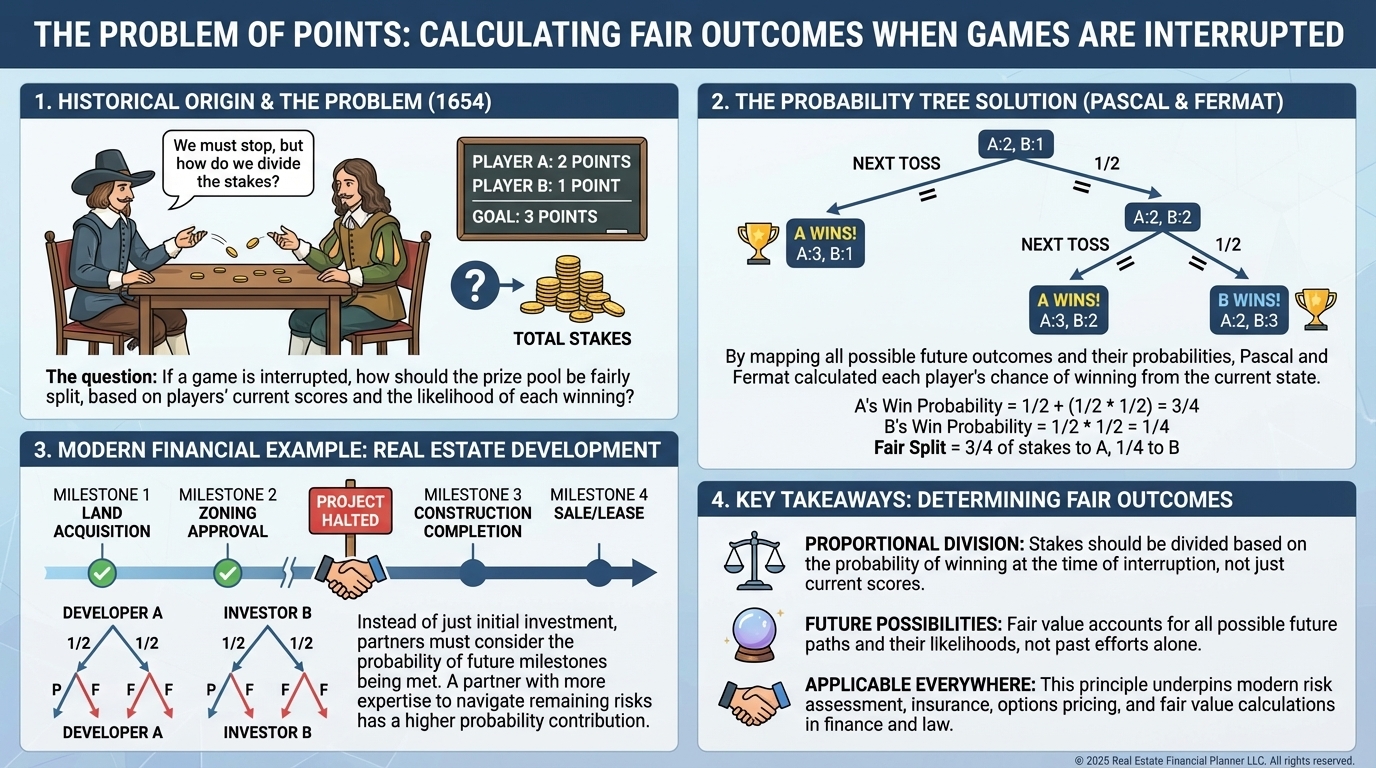
Why “Splitting the Difference” Is Often the Wrong Decision
Most people believe fairness means splitting things evenly.
That belief feels reasonable.
It’s also often wrong.
The Problem of Points is a classic idea from probability theory that shows why equal splits frequently misprice reality. While it originated in mathematics, it applies directly to negotiations, partnerships, and decisions where outcomes are incomplete.
Understanding it changes how you think about fairness, leverage, and expected value.
What Is the Problem of Points?
The Problem of Points asks: If a competitive process is interrupted before it ends, how should the remaining value be divided fairly?
The key insight is this: Fair does not mean equal. Fair means proportional to expected outcomes.
If two parties have different probabilities of success going forward, they do not have equal claims on the remaining value.
A Brief History (And Why It Still Matters)
The problem dates back to the seventeenth century and early probability theory. Mathematicians were asked to resolve disputes over unfinished games played to a fixed number of points.
If the game stopped early, how should the prize be divided?
Their conclusion was uncomfortable but precise:
You calculate how likely each player is to eventually win.
You divide the prize according to those probabilities.
This was one of the earliest formal uses of expected value.
What the Problem of Points Leads To
Once you accept the logic of the Problem of Points, three ideas follow naturally.
Expected Value
Fair decisions are based on probability-weighted outcomes, not symmetry.
Risk Pricing
Value depends on what risks remain, not what risks were already taken.
Forward-Looking Fairness
Past effort is irrelevant once future outcomes diverge.
These ideas are uncomfortable because they contradict social instincts.
They are powerful because they describe reality accurately.
Why This Concept Keeps Showing Up
The Problem of Points appears anywhere decisions are made mid-process:
•
Negotiations
•
Partnerships
•
Investments
•
Legal disputes
•
Business exits
Whenever someone says, “Let’s just split the difference,” this problem is lurking underneath.
Understanding it doesn’t make you aggressive.
It makes you precise.
Final Thought
The Problem of Points teaches a single lesson: Fairness lives in future likelihood, not past effort.
Once you internalize that, many decisions become simpler, calmer, and more rational.
We will look at this example closer in real estate investing, selling cash-secured puts and as a business owner: